Content-addressed document sets and LightRAG in production
Most RAG pipelines rot the moment someone edits a document.
In robotics operations, teams rely on Standard Operating Procedures (SOPs), hardware manuals, and incident playbooks. Those documents change constantly. If an AI agent’s answer changes from Tuesday to Thursday, or an evaluation score drops by 15%, you need to know whether the model drifted, the prompt changed, or someone quietly rewrote battery-fault-triage.md.
When I built the knowledge graph and RAG stack in Cortex, the goal was to make knowledge retrieval reproducible, observable, and fast enough for live agent loops.
Versioned, content-addressed document sets #
Instead of pointing a vector store at a mutable folder of files, I built DocumentSet as a versioned primitive backed by content-addressed blobs in MinIO.
Every file is hashed on upload and stored by its content digest. A DocumentSetVersion is an immutable manifest mapping (path → blob_digest) with composite (org_id, id) foreign keys enforcing tenant isolation at the database layer.
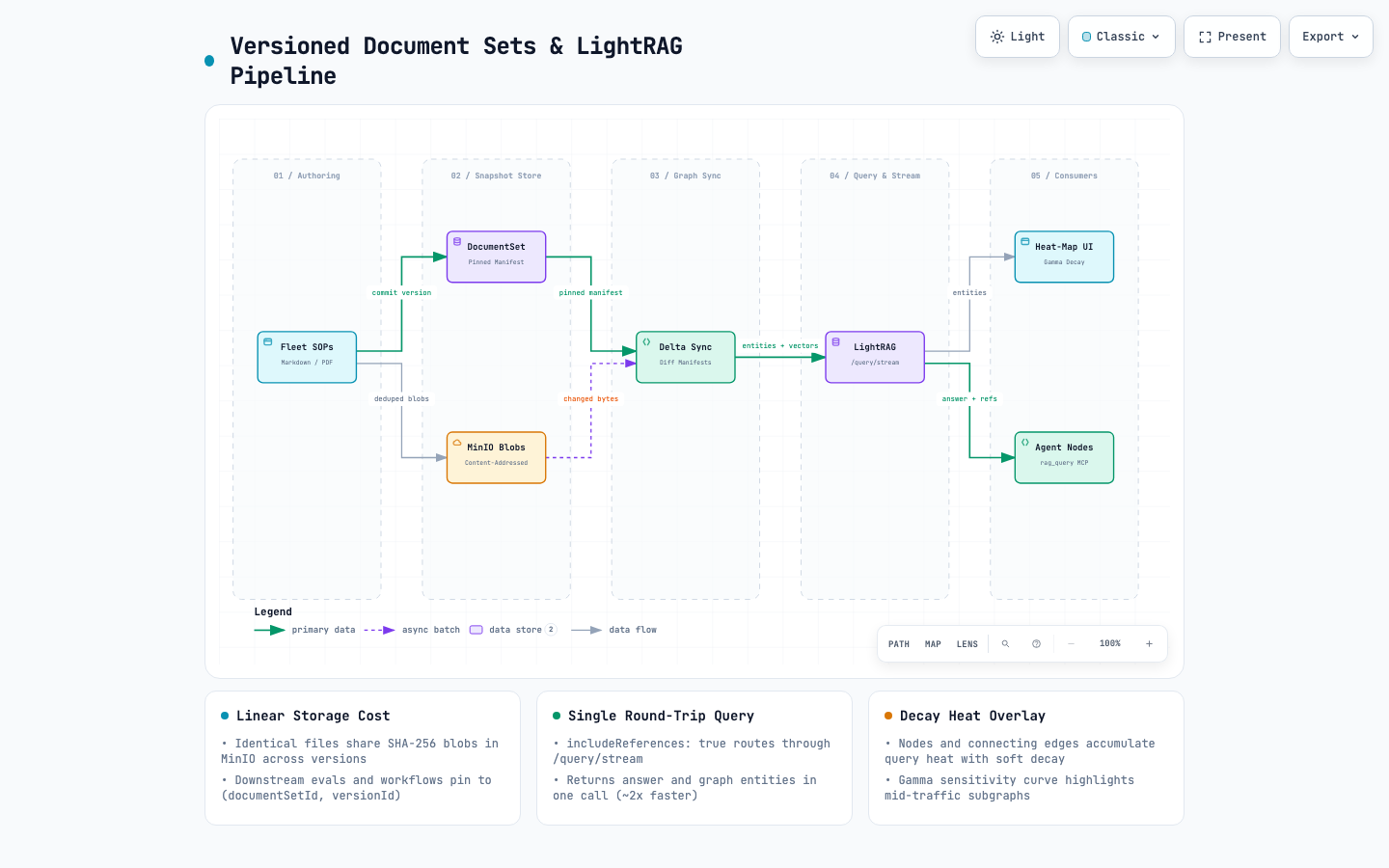
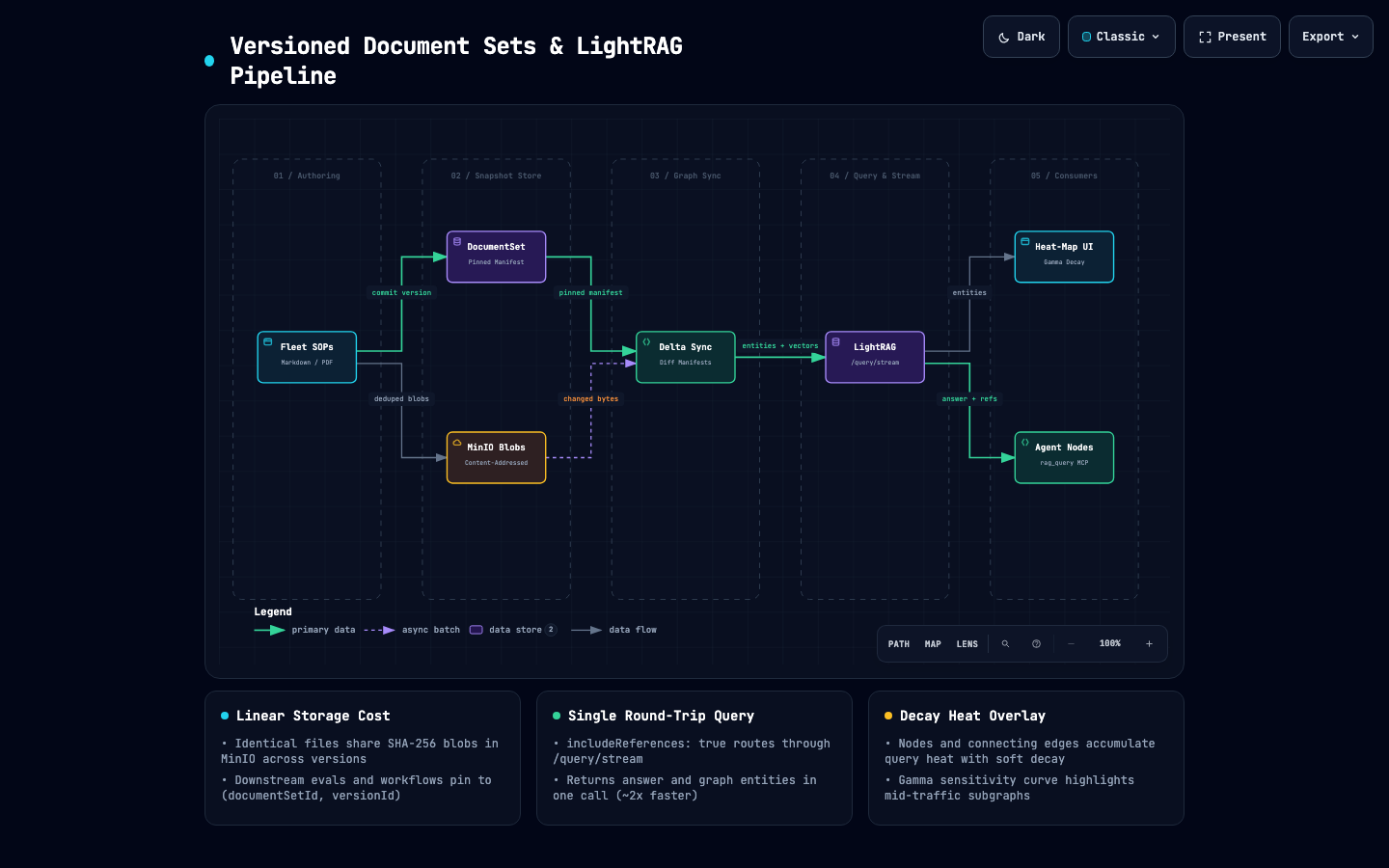
Because identical files share the same blob across versions, storage cost scales linearly with changed files rather than version count. More importantly, downstream consumers — LightRAG knowledge graph builds, workflow nodes, and evaluation datasets — pin to a specific (documentSetId, versionId). When a document set updates, we run a delta sync against the previous manifest instead of rebuilding the entire knowledge graph from scratch.
Cutting uncached LightRAG latency in half #
We integrated LightRAG to combine graph entity traversal with vector retrieval (local, global, hybrid, and mix modes), exposing it as both an MCP tool (rag_query) and a native workflow node (rag-retrieve).
In production, uncached semantic queries on the Knowledge Graph console were taking 36 to 45 seconds. Digging into the spans and logs showed two things:
- Context-only retrieval in LightRAG took
~0.4–0.8s, and cached hybrid queries took~0.95s, but an uncachedhybridsynthesis spent~36sbetween keyword extraction and LLM answer generation. - Worse, our proxy service was making two separate calls to LightRAG for every query: one to generate the answer, and a second context-only call just to extract the participating graph entities so the UI could highlight them.
Routing the query through LightRAG’s /query/stream endpoint with includeReferences: true returned the streamed answer and the referenced entities in a single round-trip. That eliminated the duplicate call (and a fragile JSON-parsing step on the second payload) and cut end-to-end query latency nearly in half.
Visualizing retrieval with a decay heat-map #
Once a knowledge graph has a few hundred entities and edges, a static node-link diagram doesn’t tell you whether your agents are actually using it well. Some regions of the graph get hit on every incident; others are dead weight from a manual nobody reads.
I added an opt-in heat-map overlay to the knowledge graph canvas. Every query updates a heat score on both the retrieved nodes and the edges connecting two participating entities, with a soft exponential decay over time.
Because retrieval distributions are heavily skewed — a handful of hub entities get pulled into almost every context window — a linear color scale makes 95% of the graph look cold. Adding a gamma sensitivity curve (display = Math.pow(heat, gamma), defaulting to gamma = 0.5) compressed the dynamic range so mid-traffic subgraphs glow clearly without washing out the hot spots.