Sandboxed code mode, recursive LLM calls, and judges that read reasoning
Standard tool-calling loops fall apart when an agent has to fan out across a fleet.
If you ask an agent to inspect 10 drones, take a photo on each, classify the anomaly, and clear the alarm, a standard ReAct loop takes dozens of serial turns. Every intermediate JSON payload lands in the conversation history, bloats the context window, and burns tokens re-reading old tool outputs.
Over the past year on Cortex, I built our persistent-agent runtime around a different model: sandboxed code mode, recursive oneshot LLM sub-calls, unified wake signals, and evaluation judges that inspect operator reasoning.
Hardening code mode with bubblewrap and stdio JSON-RPC #
Instead of calling one tool per turn, a code-mode agent writes a TypeScript or Python program (execute_typescript / execute_python) that loops, branches, and fans out concurrently.
Early on, local sandboxes ran as child processes under the pod user with scrubbed environment variables. That’s not real isolation — /proc/*/environ, local sockets, and outbound network egress are still reachable if prompt injection lands in a tool response.
I hardened the runner using platform-native sandboxing (bubblewrap on Linux pods, seatbelt on macOS) with network access completely disabled (allowNetwork: false). To let sandboxed code still call MCP tools without opening any network sockets, the external_* tool bridge runs over stdio JSON-RPC pipes between the sandbox and the host process:
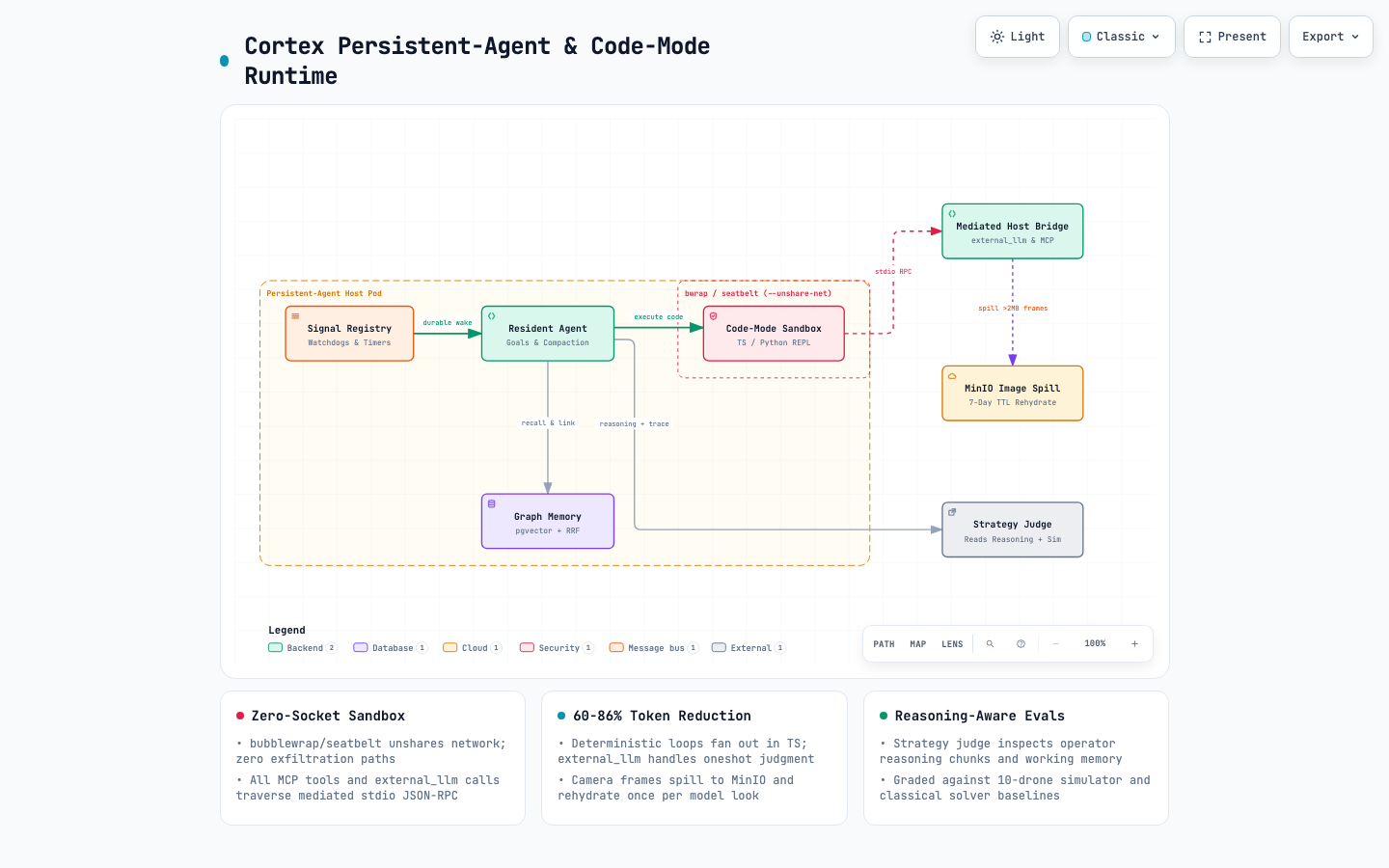
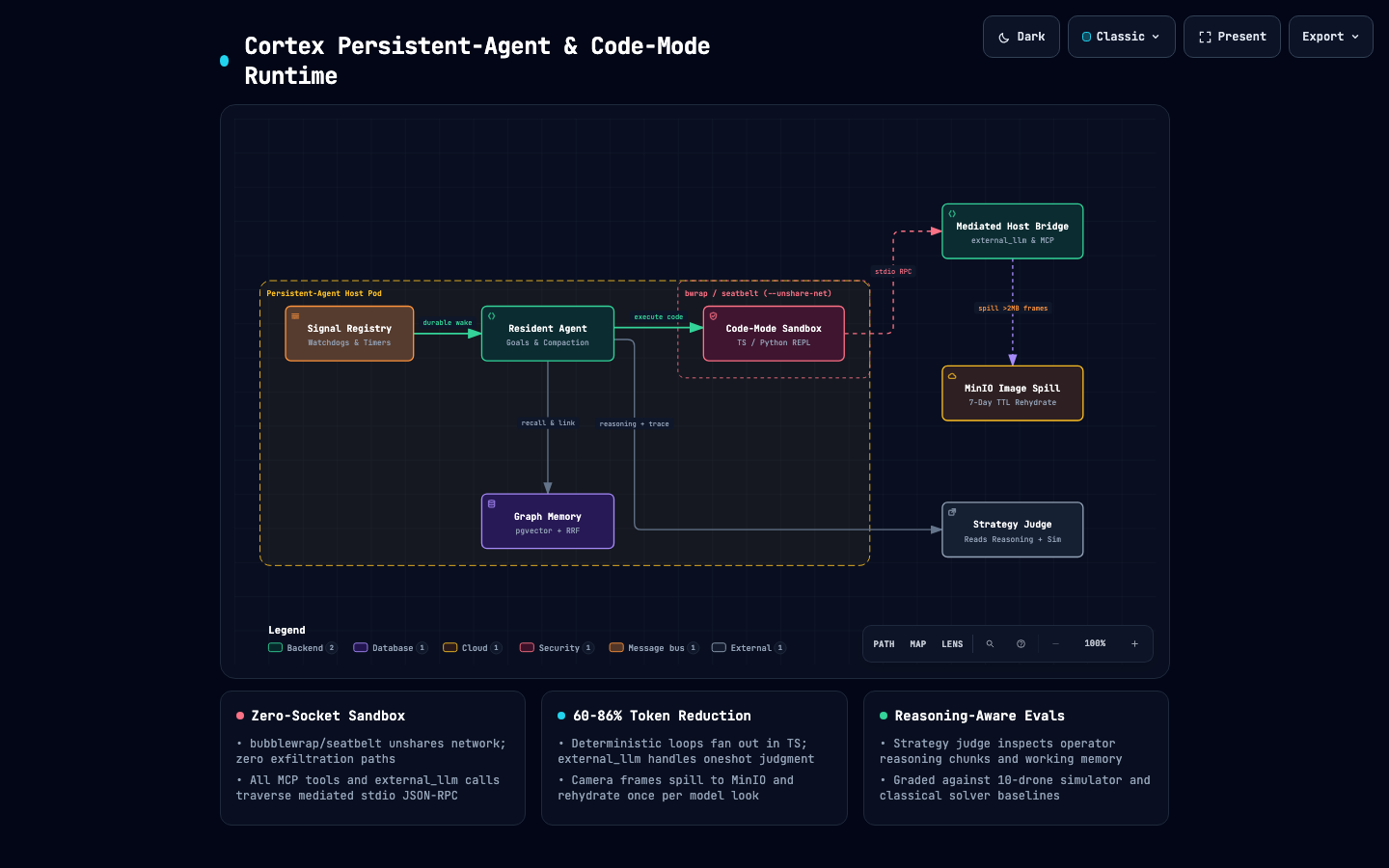
Inside the sandbox, code has pure compute and zero network exfiltration paths. And when an MCP tool returns a 5 MB camera frame, the host intercepts the base64 image before JSON.stringify, spills it to MinIO with a 7-day TTL, and rehydrates it just-in-time for a single model look-message so the agent’s transcript never OOMs the host.
external_llm: recursive judgment inside deterministic loops #
Code mode is great at deterministic orchestration (Promise.all, retries, filtering), but terrible when step 2 of a loop needs fuzzy judgment — like reading a thermal anomaly report and deciding whether it’s a false alarm. Without a bridge, the script has to exit and hand control back to the outer agent turn.
I added external_llm: a stateless, oneshot completion (no history, no tools, optional JSON schema) exposed directly inside execute_typescript:
const photos = await parallel(events, 4, e =>
  external_take_photo({ event_id: e.id })
);

const verdicts = await parallel(photos, 3, p =>
  external_llm({
    prompt: `Thermal anomaly report: ${JSON.stringify(p.value.metadata)} — verdict?`,
    schema: {
      type: "object",
      properties: {
        verdict: { enum: ["confirmed", "false_alarm", "inconclusive"] }
      },
      required: ["verdict"]
    }
  })
);

await parallel(verdicts, 5, v =>
  external_override_resolution({
    event_id: v.id,
    verdict: v.value.object.verdict
  })
);
Deterministic TypeScript handles the fan-out and concurrency limits; the LLM is called only for the 50-token classification in the middle. Across our task-flow and persistent-agent workloads, keeping intermediate payloads out of the main loop cut median prompt tokens by 60–86% and wall-clock time by over 80%.
One signal registry for waking sleeping agents #
Persistent agents shouldn’t spin in while (true) loops waiting for the world to change. Originally we had seven different wake mechanisms scattered across the codebase — cron heartbeats, MCP pollers, regex watchdogs, BullMQ wake queues, and peer messages — three of which were nearly identical polling loops with different schemas.
I consolidated them into a single PersistentAgentSignal registry (trigger doorbells, drive scorecards, and timer crons) backed by an append-only fire log. A single signal-tick worker claims due signals with SELECT ... FOR UPDATE SKIP LOCKED, runs the shared MCP invoker or wake_when regex matcher, and pushes wake events onto the agent’s command channel. We also added run_tool_when — host-side reflex actions that fire a tool immediately when a watchdog matches, without waiting for an LLM turn to wake up.
Letting the strategy judge read the operator’s mind #
To benchmark these agents, we run them against a 10-drone delivery-fleet simulator and grade every run with polymorphic JudgeBinding evaluators (ground-truth node scorers, LLM rubric judges, and classical greedy/Hungarian/auction solver baselines).
When I looked at why our strategy judge was producing shallow feedback, the bug was obvious: we asked the judge to evaluate the agent’s strategy, but buildRunDigest only fed it the simulator’s action log. Given only timestamps and tool calls, the judge just recited telemetry back to us:
“Recognized that thermal_anomaly events require drone_15 and routed all 9 events to it (t+334s, t+378s, t+452s…)”
That’s a list of clicks, not a critique of reasoning.
I updated the benchmark harness to extract the agent’s persisted reasoning chunks and working-memory updates (standing_rules, world_state, open_commitments) and pass them to the judge alongside the action log, plus a suggest_next_attempt step. Once the judge could compare what the agent thought was happening against what the simulator actually did, it started catching real failure modes — like an agent formulating a solid dispatch rule in turn 3 and forgetting it after a context compaction in turn 12.